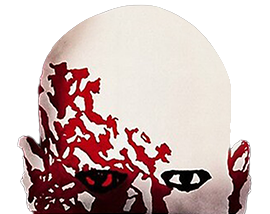
1976/77
While making Martin, Romero also starts to develop an initial story treatment for Dawn of the Dead that he will later work into a rough, 80-page partial script. This early draft tells the story of a pregnant woman and a man hiding from the zombie outbreak in crawlspaces above a shopping mall, with the male serving as a “hunter” getting supplies from the stores below, and also involves a plot element about a military group feeding the undead (which, although discarded for the time being, Romero will eventually pick up again for the third installment of his original “zombie trilogy”, 1985’s ill-fated Day of the Dead).
As Romero tells Pittsburgh Press journalist Ed Blank in 1979, the original script apparently is first pitched to Sam Arkoff’s American International Pictures (who have rejected Night of the Living Dead almost a decade prior due to its “unhappy” ending). AIP are interested, but want O. J. Simpson to star in the film, which the director refuses. Via Laurel’s foreign sales agent, Irvin Shapiro, the draft eventually finds its way to Italian producer Alfredo Cuomo. Cuomo originally suggests shooting the movie in Italy with Franco Nero starring, but then hands the script over to aspiring Italian horror director Dario Argento, who turns out a huge fan of Night of the Living Dead and is very interested in collaborating with Romero on a sequel to that film.
Argento calls Richard Rubinstein, asking to see the rest of the script, which of course hasn’t even been written yet, so the producer basically pulls off a clever bluff: Dario will get to read the second half of the screenplay if he is ready to negotiate a business arrangement to co-finance the film with Laurel.

ario Argento and a still clean-shaven George Romero in front of the Monroeville
Mall’s famous clock tower during a pre-production tour of the building, circa
1977.
Argento takes the bait and flies into Pittsburgh, where he is picked up by Romero in a rented Lincoln Continental for a tour of the Monroeville Mall. By that time, Romero has discarded the original script and written a wholly new synopsis which will serve as the basis for his final screenplay.
Ultimately, an agreement is made for Dario Argento, his brother Claudio, and Alfredo Cuomo co-financing the project; with Argento in turn being granted the rights to re-edit the finished film at his own discretion for all non-English-speaking markets apart from Latin America (i. e. the whole of Europe and Japan). As far as the film’s total budget goes, both Rubinstein and Romero himself over decades are going to spread the myth that Dawn cost around $1.5 million to make, although both a 1978 Cinefantastique article by David Bartholomew and a Michael Gornick interview for Questar magazine the following year are hinting at a much smaller budget of about $400,000.
In his audio commentary recorded for the “Extended Version” from Anchor Bay’s 2004 “Ultimate Edition” four-disc Dawn DVD box set, Rubinstein will eventually reveal in public for the first time that the budget had in fact been in the range of just around $640,000 “on paper” (with an actual physical cash flow of half a million), and that he merely has blown up the figures to make the film look “bigger”, thus being able to sell it to distributors at a higher price.
The lion’s share of that amount, around a quarter of a million dollars, is provided by the trio of Italian investors in Rome (in the form of a credit letter), with Romero and Rubinstein themselves also chipping in $25,000 each. The rest of the financing comes from Mark Mason and his Oxford Development co-president, Edward J. Lewis, as well as Pittsburgh-based insurance entrepreneur Alvin Rogal (who, in addition to raising the highest single domestic investment of $80,000, also handles the production’s general insurance business) and various other parties, which even includes a cousin of Rubinstein’s from Buenos Aires, Argentina.
Romero’s friendship with Mason (as well as a reported fee of $40,000 plus a six-percent share in box office profits) enables him to actually use the Monroeville Mall as a physical shooting location for Dawn of the Dead during non-business hours, from around 10 P.M. to 7 A.M. Out of the 143 stores the facility is housing at the time, only 13 refuse to be filmed. Permission also is given to use the mall’s “Ice Palace”, a large indoor ice skating rink located on its lower level, which will feature prominently in the finished movie.
May 1977

1977 ‘Variety’ trade ad for the Cannes screening of ‘Martin’
Laurel’s co-financing deal for Dawn of the Dead with their Italian partners gets finalized at the Film Festival in Cannes, France, where Romero and Rubinstein are also selling international distribution rights for Martin.
Circa Mid 1977

DOTD SCRIPT
Upon invitation by Dario Argento, Romero, accompanied by his partner and assistant Christine Forrest, writes the entire final shooting script for Dawn of the Dead in Rome, where the couple is accommodated in a lovely apartment located near the Colosseum. Argento provides hospitality, and hosts regular dinners over which the two men are discussing the script’s progress in what Christine Forrest later describes as mainly being “body language”.
Completed in about three weeks, the screenplay
ultimately runs over a total of 253 pages with 750 individual scenes; including an alternate ending that has both Peter and Fran committing suicide rather than escaping the mall together.
Summer 1977
Pre-production for Dawn of the Dead begins, and George Romero makes what well may be the very first mention of the project to any public media while talking with Pittsburgh Post-Gazette entertainment editor George Anderson (who has literally covered every little step of the director’s career on a regular basis in his columns since the early 1970s) for an article that mainly revolves around his then most-current work, Martin.
In addition to revealing that “it’s another horror film,” Romero also tells the journalist about the involvement of Dario Argento, and that he just recently has finished the script in Italy. According to Anderson’s piece, which is published in the paper’s July 13, 1977 edition, filming for the “untitled” movie is “probably beginning in September.”
Fall 1977
Casting sessions for the film are held in New York City. Two of the film’s three male leads, David Emge and Scott Reiniger, are recruited from the staff of a Lower Manhattan restaurant called “Lady Astor’s”, which serves as some kind of temporary workplace for what will eventually become known as “the Romero family” in between movie projects, and also includes John (Martin) Amplas, Dawn production manager/lead zombie Jay Stover, and George’s assistant director (and later wife), Christine Forrest.
The two remaining stars, Ken Foree and Gaylen Ross (who has no real acting experience whatsoever and thus hands George Romero a fake resume) are auditioning for their respective roles after they have heard about the local casting from friends.

A rare still of actor Ken Foree (center) in his only pre-‘Dawn’ feature film
role, appearing in John Badham’s 1976 sports comedy ‘The Bingo Long Traveling All-Stars & Motor Kings’.

An even more vintage headshot of future ‘Flyboy’ David Emge from a 1970s ‘Pittsburgh Playhouse’ theater program.
November 6, 1977
Principal photography for Dawn of the Dead commences at the Monroeville Mall, with the first exterior shots of zombies roaming the facility’s parking lot being filmed.
November ??, 1977
Dawn’s four main actors travel from New York into Pittsburgh together, on a flight that has to circle over their destination airport for about 45 minutes due to heavy turbulences which, according to Gaylen Ross, affect Ken Foree so much he secretly throws up in the plane’s lavatory.
November 13 - December 12, 1977

George Romero, Michael Gornick and assistant cameraman Tom Dubensky setting up an (ultimately unused) establishing shot of Paul Musser’s baldhead zombie character at the airfield, November 1977.
A busy shooting schedule that has the cast and crew working six-day weeks (later even expanded to seven) will see Romero moving the film’s production back and forth between the Monroeville Mall and several other locations in and around Pittsburgh, in order to get as many set-ups and shots as possible.
Key scenes filmed beyond the mall during this period include Peter and Roger getting the Macks at the “B&P” truck yard, the airfield sequence, the confrontation of the four heroes with a group of policemen at the boat dock, the redneck posse “hunting” scenes, and the S.W.A.T. housing project raid, which takes a total of seven days to shoot.